In February of this year, Pharrell Williams was named Louis Vuitton’s men’s creative director, a decision which was understood as an unusual one in the luxury fashion world but one that was clearly significant. As Jon Caramanica puts it:
His appointment to the helm of Vuitton’s men’s business is, depending on your perspective, a full-throated acknowledgment of the power of Black cultural capital on a global stage and a watershed moment in the absorption of hip-hop class politics into luxury fashion. Or it’s a bellwether of challenging times to come for traditionally trained clothing designers who aspire to top posts, and a suggestion that global celebrity moves the needle more than directional design, even for the most successful luxury brands.
The decision to appoint him could not fairly be characterized as without precedent. In fact, he is preceded in this role by Virgil Abloh, the Ghanian American designer from Chicago, whose brand Off-White was one of the biggest streetwear brands in the world. However, that appointment was less radical to some degree as Abloh’s trajectory was one that—while unlike many of the white, European and wealthy doyens of the luxury fashion world—was still very much rooted in design. With a background in engineering and architecture, Abloh’s appointment as head of Louis Vuitton men’s could be explained without too much difficulty. But, as Caramanica notes, the decision by LVMH to appoint Williams was a statement about the influence of Black culture across the globe but also about the increasing reliance of luxury fashion on celebrity. Just looking at the reports from the fashion show unveiling LV’s Men’s S/S 2024, the first under Williams’ stewardship, it is clear that it was dubbed a “watershed” moment because of the celebrity guest list: Beyonce, Jay-Z, Quavo, Rihanna, A$AP Rocky and Zendaya, to name a few.
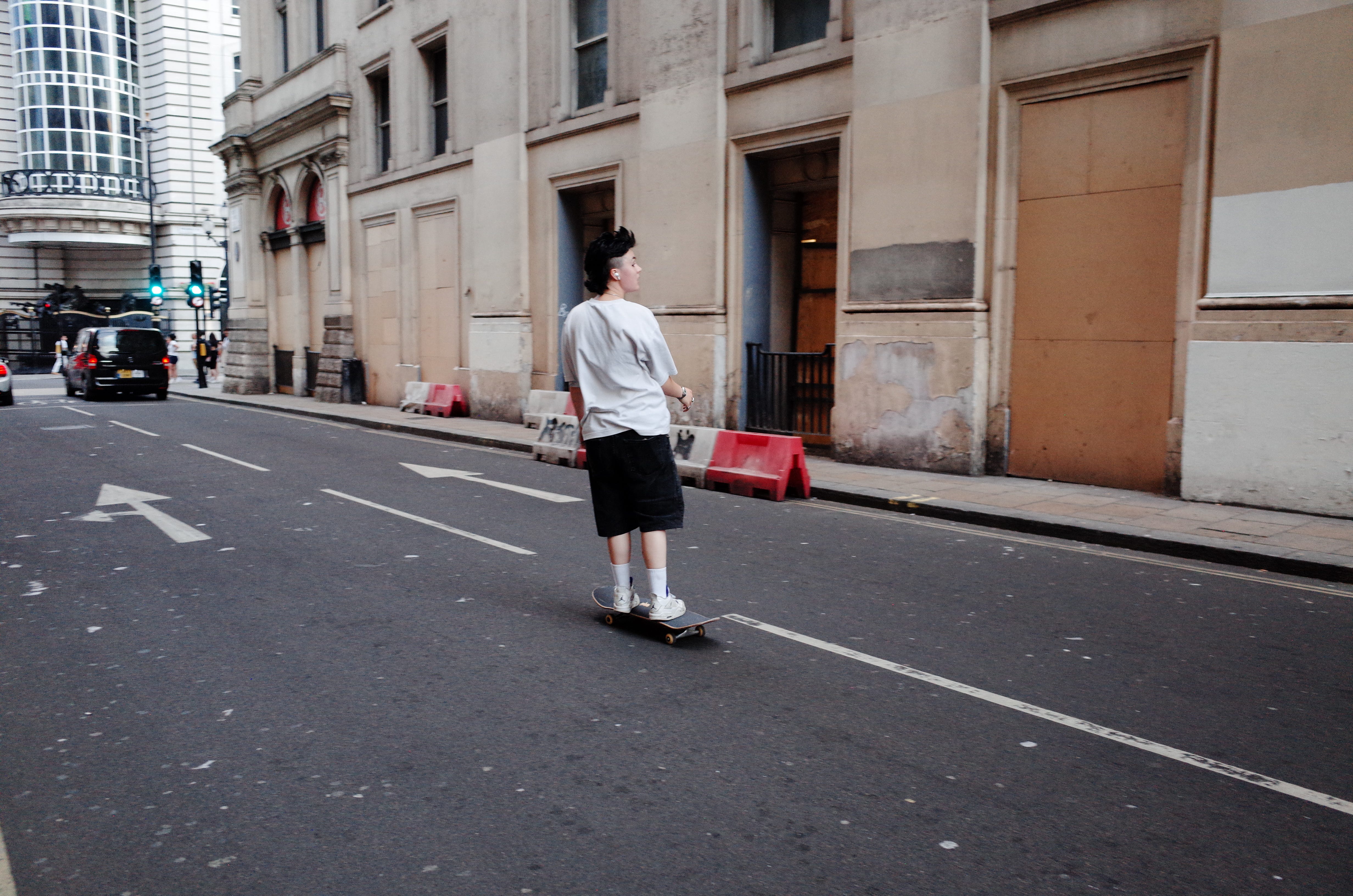
Far less talked about in these reports is Pharrell’s groundbreaking role in hip hop, which preceded his appointment at LVMH by two and a half decades. What made him stand out in the hip hop scene of 1990s could be captured by one of his nicknames—Skateboard P. The entrée of a skater aesthetic into hip hop wasn’t exactly brand new. But no one had done it the way that Pharrell had. To be behind the beats for some of the grimiest cocaine rap at the time and also to have really catapulted into stardom through a song called “Super Thug,” all the while looking like someone who could do an ollie, Pharrell preceded Kanye West in terms of expanding the dress code (and racial politics) in hip hop.
Part of this could be explained by Pharrell’s upbringing in suburban Virginia. Skateboarding at least in its folk history is decidedly suburban in origin—specifically, beach towny. Skateboarding comes out of surfing. It was what surfers did when the conditions weren’t favorable. Hence, the earliest form of skateboarding was ramp skating and pool skating. Only those in relatively nice suburbs with yards and pools could afford to participate in such an activity. As the skateboarder (and Leica photographer) Ray Barbee notes, skateboarding’s roots in surfing explains the degree of racial and economic homogeneity in skate culture. It came out of an activity that was already inaccessible for most. For Barbee, the backlash he received when he began skateboarding in his hometown of San Jose, California in the Bay Area was from other Black folks.
I got the most grief from other brothers and sisters—from other blacks. And they were always like, “Why are you trying to be white?” And I was like, “I’m just riding a skateboard, I love what I’m doing—I hope you dig what you’re doing.”
To be fair, over the last three decades, there has been a notable shift in the culture about what a “skateboarder” looks like, which Pharrell (along with Lupe Fiasco and Lil Wayne) is largely responsible for. But culture does not shift thanks to a single figure or a set of figures. Change occurs via movements that take advantage of timing and the availability of resources, as scholars of social movements have taught us. And this is no different in the case of the rise of skateboarding in urban communities. As Barbee himself notes, the 90s gave rise to “street skating,” which he suggests is what “opened the floodgate of diversity.”
Skateboarding rolled out of the backyards and literally into the streets as skaters realized that you didn’t need a ramp to skateboard or turn pro—all you needed was cement.
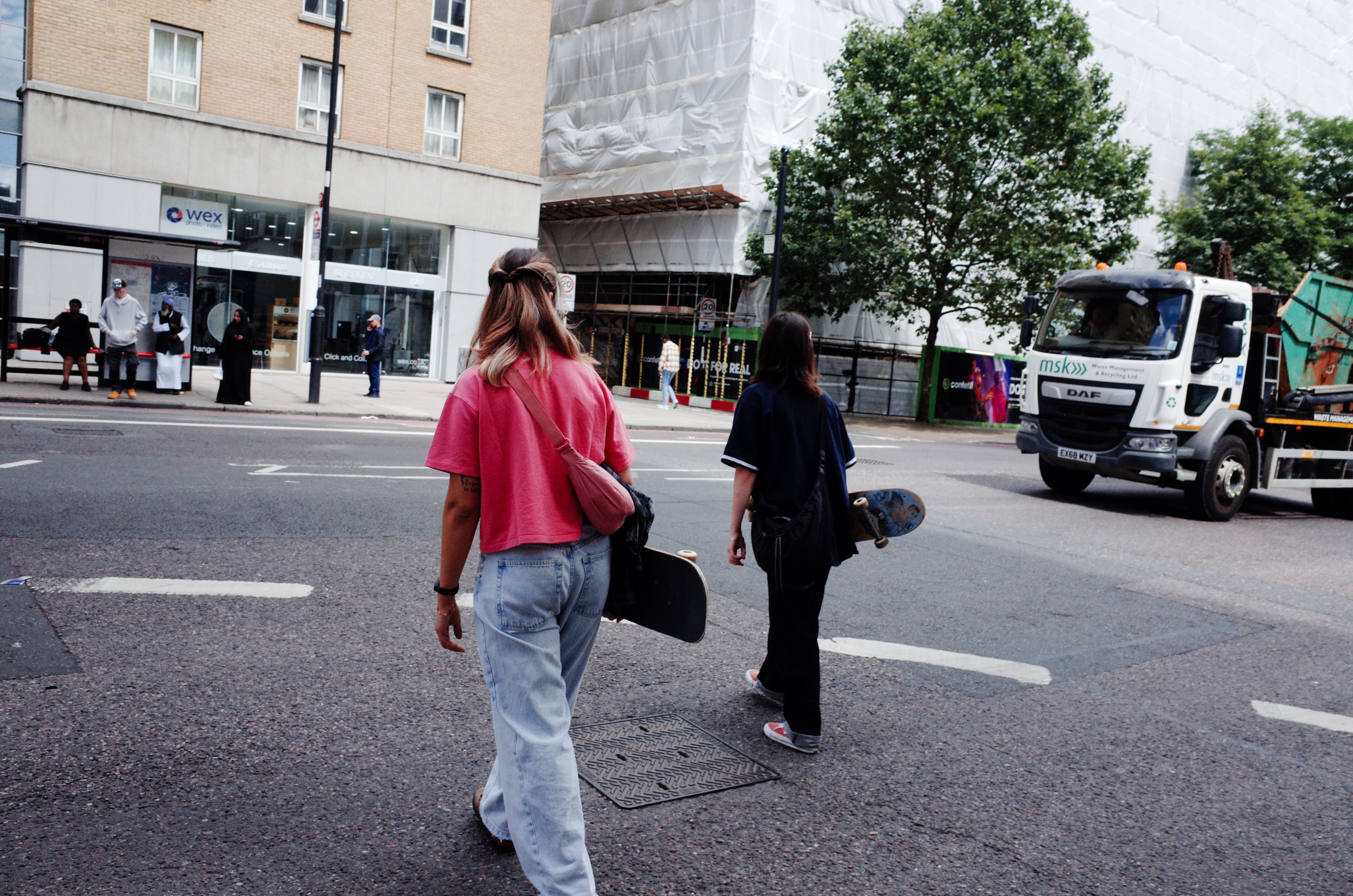
But what street skating wrought was its increased take-up by young men who weren’t white and from the suburbs. It did not necessarily translate to more women getting on decks. Skateboarding, throughout the 90s and early 2000s, was seen as a masculine activity, albeit one that now consisted of young men dressed in baggy clothes and Vans in all manner of urban environments. This is in spite of the fact that a photograph of Patti McGee, the world’s first woman professional skateboarder, was printed on the cover of Life in 1965.
Skateboarding has a specific visual culture, made up of skate magazines and videos. The iconic photographs of skateboard culture by Glen E. Friedman and Ed Templeton hardly featured women. Kelefa Sanneh, in his review of Templeton’s recent photo book Wires Crossed, writes:
“Wires Crossed” is in large part a book about survival. It includes interviews, at the end, with a handful of its subjects, including Elissa Steamer, who often found herself the only woman skater in a van full of guys, and who found it bittersweet to see photographic evidence of “how fucked up I was back then.” (She says she has been sober for fourteen years.) Another skater, Brian Anderson, talks about how he felt that he couldn’t let any of his friends or fans know that he was gay—it turns out, of course, that the comrades in the van didn’t really know everything important about one another.
The insularity of the subculture is something that Templeton’s wonderful photographs draw out. This is the case more broadly with skate photography as Jaime Marie Davis argues.
One thing that’s really important, and has been integral to what skate photography is today, is that it’s always being shot by people who are within the culture, versus someone that is outside of the culture. It’s not people going into a subculture and shooting it and taking it back out for a different audience. Skating is shot from the audience, within the audience, and for the audience.
For Davis, the curator of Against the Grain, “a cultural programme specialising in the histories, archives, and collections of skateboarding photography,” the insider status of skateboarding photographers brings authority via authenticity. But this means that the largely white, masculinist status quo can simply be reproduced in—and by—skate media.
According to researchers, skateboarding, especially street skateboarding, contains gendered divisions "based upon the logics of individualism and embodiment.” Skateboarding, they see, as a “field” in the sense used by Pierre Bourdieu. Each “field” is a zone of competition with a a dominant set of “idealized practices and taste distinctions which operate within a particular social field can access material, social and cultural benefits.” This is of course the famed notion of habitus. In any social “field:”
The habitus, carrying the residue of specific cultural, social and personal histories, represents a form of physical capital that can be translated into economic capital (e.g. money, services, property), social capital (e.g. power and status) and cultural capital (e.g. educational and professional opportunities).
As skateboarding’s identity became increasingly oriented towards “the street,” risk and social rebellion became part of the dominant habitus. And thus, traditionally masculine habituses, with risk-taking and “badassness” as key features, became rewarded with social and cultural capital. Traditionally feminine habituses, with risk-aversion as a key feature, were, as such, bereft of capital. Capital, in this case, if we are to take seriously the words of the curator Davis, is authenticity. Women, therefore, were seen as inauthentic participants in the culture—“posers,” “putt putts” and “groupies” as one young skater put it. Carly, a young woman skater interviewed in a study by Atencio, Beal and Wilson, comments that:
…the men would treat the women ‘like dogs’ and said that the men always challenged [my] knowledge of skateboarding…[D]uring the skate sessions [my] boyfriend would push [me] to skate ‘harder’ by calling [me] a ‘poser’.
In the same study, women skaters reported to the researchers that an additional insult was to accuse women of only using longboards, a type of board that is longer and thus more stable (and thus more “feminine”) than skateboards.
What was once an insult is now being reclaimed as longboarding has picked up among women, precisely because of its supposedly feminine qualities. In an interview with Vogue, a South Korean longboarder named Ko Hyojoo, who has an Instagram following of more than 500,000 followers, says it is “more amusing” and “looks more stylish.”
The changing landscape of skateboarding came to a head during the pandemic, during which skateboarding exploded, especially in New York. Second only to sourdough bread, skateboarding’s popularity rose to the point where skateboarding equipment sales doubled between February and June 2021. Part of this boom was the uptake of skateboarding by Asian, Latino, Black, queer and women skaters. But because of its extant masculinist politics of authenticity, organizations for underrepresented skaters began springing up in order to mitigate the anxiety of skate parks. As one skater put it:
“I’m already different,” someone might think. “I can’t be bad, too.” As a beginner, I visited my local skate park in the early mornings, hoping to minimize the number of eyes on me.
Organizations Quell, Late Skate, Sk8 Babes and Skate Like a Girl put on skate events, or “clinics,” with the goal of creating a space for skaters both new and old.
These may have already had some sort of positive impact. A study conducted by USC and the Tony Hawk Foundation (yes, that Tony Hawk) found that skateboarding helps to “build resilience among young skaters, and helps them form communities across backgrounds.” According to Zoe Corwin, a researcher involved in the study:
The stereotype is white stoner guys. The reality in 2020 is the skateboarding community is really, really diverse, and not only are they diverse, for many skaters, that’s a point of pride.
Let’s hope that it’s true.
References
Atencio, Matthew, Becky Beal, and Charlene Wilson. “The Distinction of Risk: Urban Skateboarding, Street Habitus and the Construction of Hierarchical Gender Relations.” Qualitative Research in Sport and Exercise 1, no. 1 (March 1, 2009): 3–20. https://doi.org/10.1080/19398440802567907.
Bailey, Hannah. “Industry Insights: The Rise of Women Skate Photographers.” British Journal of Photography (blog), June 21, 2022. https://www.1854.photography/2022/06/industry-insights-the-rise-of-women-skate-photographers/.
Barksdale, Aaron. “How Skateboarding Became More Than A White Dude’s Sport.” HuffPost UK (blog), December 4, 2015. https://www.huffpost.com/entry/how-skateboarding-became-more-than-a-white-dudes-sport_n_55fb8f4ee4b0fde8b0cdc827.
Caramanica, Jon. “Pharrell Williams, Louis Vuitton’s New Don.” The New York Times, June 18, 2023, sec. Style. https://www.nytimes.com/2023/06/18/style/louis-vuitton-menswear-pharrell-williams-louis-vuittons.html.
Cowan, Jill. “How Skateboarding Can Help Fight Racism.” The New York Times, June 18, 2020, sec. U.S. https://www.nytimes.com/2020/06/18/us/usc-skateboarding-study.html.
Gonzalez, Tara. “Pharrell Delivers a True Pop Culture Moment at Louis Vuitton.” Harper’s BAZAAR (blog), June 21, 2023. https://www.harpersbazaar.com/fashion/fashion-week/a44269082/pharrell-williams-louis-vuitton-debut-show/.
Hughes, Jazmine. “The New Skaters of New York.” The New York Times, August 5, 2021, sec. New York. https://www.nytimes.com/interactive/2021/08/04/nyregion/new-york-skaters.html.
Manatkis, Lexi. “Six Photographers Who Shaped How We See Skateboarding.” Dazed (blog), July 6, 2018. https://www.dazeddigital.com/art-photography/article/40596/1/photographers-influenced-skate-against-the-grain-spike-jonze-glen-friedman.
Maoui, Zak. “Every Single Star That Showed up at Pharrell’s First Louis Vuitton Show.” British GQ (blog), June 21, 2023. https://www.gq-magazine.co.uk/article/louis-vuitton-pharrell-ss24-menswear-guests.
Marjon, Carlos. “Meet Ko Hyojoo, the South Korean Longboarding Sensation.” Vogue (blog), June 27, 2016. https://www.vogue.com/article/skater-south-korean-ko-hyojoo-longboarding-kero-one.
Sanneh, Kelefa. “Ed Templeton’s Unsparing Photographic Diary of Skateboarding Life.” The New Yorker, May 22, 2023. https://www.newyorker.com/culture/photo-booth/ed-templetons-unsparing-photographic-diary-of-skateboarding-life.
Strong, Jack. “Pharrell Launches His Louis Vuitton-Loaded @skateboard Instagram Ahead of His Runway Debut.” The Sole Supplier (blog), June 20, 2023. https://thesolesupplier.co.uk/news/pharrell-launches-his-louis-vuitton-loaded-skateboard-instagram-ahead-of-his-runway-debut/.
great stuff