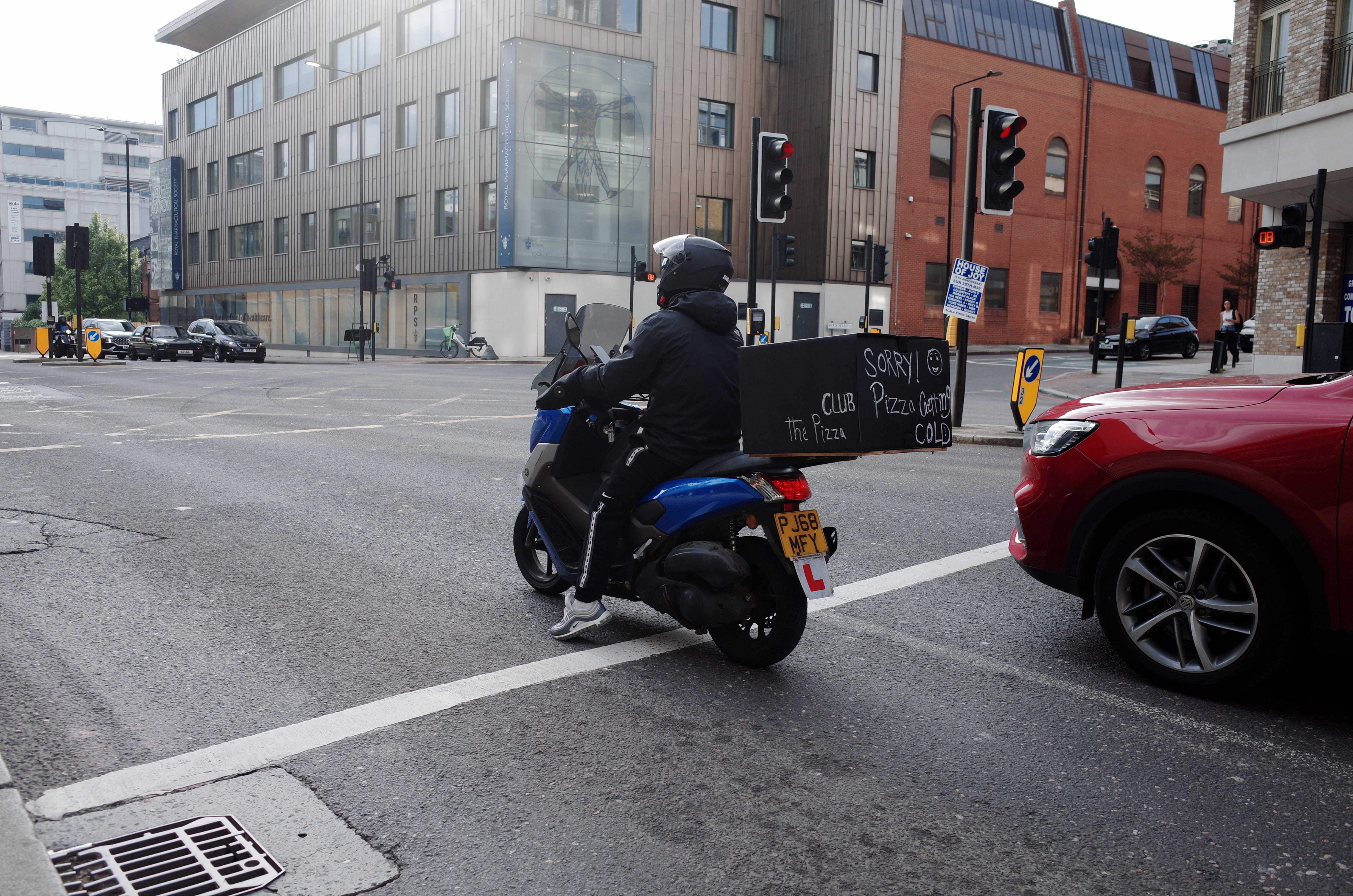
The idea that a scooter driver needs to bob and weave through London traffic in order to make a delivery is not all that remarkable. He (or the box affixed to the back of his bike) is asking for forgiveness in advance. The humor contained in the message only works—and by that, I mean it can only elicit a chuckle—if we understand ourselves to not only be on the receiving end of his behavior on the road and thus maybe even be annoyed, but also the fruit of his labor. In other words, we can imagine ourselves anxiously checking our phones to see the progress of the food as much as we can imagine ourselves behind the wheel wondering why that person is driving like that.
Many of us live in a world of convenience. Amazon, in many cities across in North America and Europe, has made it almost too easy to get anything delivered to your home—and quickly at that. Next-day delivery is not unusual in this day and age. Pizza, it just so happens, is one of the prototypical delivery items not only in the US but, as can be seen above, in the UK as well. There are over one billion pizzas delivered every year—and that’s only in America.
One could argue that pizza and delivery go hand in hand. There is the oft-told story of the birth of the margherita. According to lore, in 1889, King Umberto I and Queen Margherita visited Naples and was offered a local delicacy by a pizzaiolo named Rafaele Esposito, who put made a special pie in honor of the queen by making reference to the colors of the flag of the newly formed Kingdom of Italy—red(tomato), white (mozzarella) and green (basil). Supposedly, he hand-delivered the pie to her, completing what some believe to be the “first pizza delivery in history.”
Before the boost in its popularity in the 1950s and 1960s, pizza was generally considered a local, niche food. Brought to New York in the wave of immigration from Italy in the late 19th century and early 20th century, pizza was first sold in pizzerias around Little Italy. The first licensed pizzeria in New York City, Lombardi’s, is still around. What catapulted this specialty food, mostly limited to Italian immigrants and adventurous New Yorkers, into mass culture was the return of American GI’s from Europe. Those who had served in Italy during World War II had come back with a penchant for pizza. In the 1940s, not only did pizza begin to pop up on menus in restaurants outside of New York City. It was in the 1960s that pizza’s proliferation amongst the American populace was solidified thanks to the availability of the frozen variety. Likewise, pizza specialty restaurants—called “pizzerias” in some regions and “pizza parlors” in others—sprung up. These soon replaced other spaces like candy stores as teenage hang-out spots.
The popularity of pizza resulted in the emergence of pizza chains. In the UK, Pizza Express, which is the biggest pizza chain restaurant here, opened its first branch on Wardour Street in 1965. Stateside, Domino’s, which began in Michigan in 1960, had 200 stores by 1978. What separates Pizza Express from Domino’s is the former’s emphasis on traditional, sit-down dining. In addition to its ubiquity, Pizza Express has a deep connection to music, especially jazz. It opened a jazz club in Soho in 1969. While Pizza Express’s identity is tied to its status as a place to sit down, Domino’s is quite different. Their outlets are hardly “restaurants” as much as they are commercial kitchens with a front. Walk into a Domino’s and you’ll see that it is mostly kitchen and a bit of room for the counter. Domino’s is decidedly a delivery-oriented business. The difference could be conveniently chalked up to Anglo-American cultural differences, more specifically, between London and Ypsilanti, Michigan, where each business began. Perhaps the most significant between the two cities is in transport infrastructure and its associated cultural consequences. London is a walking city with public transportation as the default mode of mobility for most city-dwellers. I don’t think it’s an accident that some of the icons of London are transportation-related—the Tube, the double-decker red bus, the black cab and so on. It makes sense then that Pizza Express would cater to urbanites that spend a lot of time away from their cramped flats. Ypsilanti, as many American suburbs, is almost entirely car oriented. Pizza eaters want to eat in their spacious homes, plopped in front of the TV.
With this in mind, it comes as no surprise that Domino’s, which started there over 60 years ago, is responsible for two major pizza delivery innovations. Domino’s is widely known as innovating the modern pizza box. Tom Monaghan, one of the founders of Domino’s, figured out that delivering pizzas in a corrugated cardboard box was perfect for delivery. It not only kept the pizzas warm and protected while also providing ventilation, they came flat and had to be folded, addressing the issue of storage in his outlets. The cardboard box, known as “Michigan style,” became the industry standard. Prior to cardboard, pizza boxes were made of what is known as paperboard, which is what bakeries used to use to deliver cakes. While also foldable, they provided very little structure and thus necessitated a tiny plastic table that held up the top of the pizza box so as to prevent the cheese and other toppings getting smushed. It also wasn’t very breathable and often resulted in a soggy pizza. Before this, pizzas were stuffed in paper bags. (Granted, they were much smaller than the standard 20-inch pies of New York.) In Naples, pizza was placed in stufas, a vented metallic container with shelves (think stackable dim sum steamers but not bamboo) for vendors to hawk pies on the streets. The main reason for this investment in pizza box development was that Domino’s was the first to guarantee a 30-minute delivery. This meant that pizza needed to not only be delivered warm but also tout suite.
Starting in just a couple of weeks, New York City’s delivery workers for apps such as DoorDash and UberEats will receive at least $18 an hour, not including tips. This, The New York Times notes, is the first piece of legislation in the country that requires a minimum wage among delivery app workers. For 60,000 of them in New York, the law will go on to raise the minimum wage to $20 an hour in 2025 or more (depending on inflation). With the number of delivery workers more than doubling since the pandemic, and so many of them not entitled to employment benefits like overtime or health insurance due to their status as both “freelance” and largely undocumented, today’s heightened rhetoric around matters of social justice must factor in workers of this kind. Many are surveilled by the platforms they deliver for. And, to add insult to injury, some have had their tips stolen by these apps. I’m hoping that one day soon the humor of “Sorry! 😊 Pizza getting cold” would be lost on us because we understand how risky and precarious their jobs are. We simply wouldn’t find it funny. Plus, cold pizza still tastes pretty good.
References
Chen, Stefanos. “New York City Sets New Minimum Wage for Food Delivery Workers.” The New York Times, June 12, 2023, sec. New York. https://www.nytimes.com/2023/06/12/nyregion/nyc-delivery-workers-minimum-wage.html.
Cohen, Joyce. “E-Bikes Are Convenient. They Can Also Cause Fatal Fires.” The New York Times, March 6, 2023, sec. Real Estate. https://www.nytimes.com/2023/03/06/realestate/e-bikes-fires-danger.html.
Gregory, Karen. “‘My Life Is More Valuable Than This’: Understanding Risk among On-Demand Food Couriers in Edinburgh.” Work, Employment and Society 35, no. 2 (April 1, 2021): 316–31. https://doi.org/10.1177/0950017020969593.
Harrison, Olivia. “This Is The Surprising Story Of The First Pizza Delivery.” Refinery29 (blog), April 10, 2017. https://www.refinery29.com/en-us/2017/04/149332/first-pizza-delivery-story.
“The Political Story of the First Pizza Delivery.” Food & Wine. Accessed July 1, 2023. https://www.foodandwine.com/news/political-story-first-pizza-delivery.
“Scott’s Pizza Chronicles: A Brief History of the Pizza Box.” Serious Eats (blog). Accessed July 1, 2023. https://www.seriouseats.com/a-brief-history-of-the-pizza-box.
Kaysen, Ronda. “I’m Ready for Deliveries at My Door Again, but My Building Still Says No.” The New York Times, March 11, 2023, sec. Real Estate. https://www.nytimes.com/2023/03/11/realestate/food-delivery-apartment-buildings.html.
Leahy, Cory. “Food Movers: The Secret Evolution of the Pizza Box.” Food+City (blog), September 4, 2017. https://foodandcity.org/evolution-pizza-box/.
Madrigal, Alexis C. “The 3 Big Advances in the Technology of the Pizza Box.” The Atlantic (blog), July 18, 2011. https://www.theatlantic.com/technology/archive/2011/07/the-3-big-advances-in-the-technology-of-the-pizza-box/242116/.
“The Most Interesting Part of Pizza Delivery Is the Story Behind the Box.” Bon Appétit (blog), August 20, 2015. https://www.bonappetit.com/entertaining-style/pop-culture/article/pizza-box-design.
Rothman, Joshua. “Pizza!” The New Yorker, December 14, 2012. https://www.newyorker.com/culture/culture-desk/pizza.
Salerno’s Pizza. “When Did Pizza Delivery Start?” Accessed July 1, 2023. https://salernospizza.com/when-did-pizza-delivery-start/.
Spectator, The. “A Slice of History: How Did Britain’s Pizza Industry Begin?” The Spectator (blog), October 10, 2019. https://www.spectator.co.uk/article/a-slice-of-history-how-did-britain-s-pizza-industry-begin/.